


Stay Up To Date With Us!
We will never spam you or share your email address.
Game Sound Design Strategies
GSD StrategiesCheck out the gamesounddesign.com strategies when you are feeling creatively uninspired. Each random strategy will present you with a new avenue to pursue. Give them a try!
Game Sound Design Glossary
GSD GlossaryOur game audio glossary has all the sound terms you have been wondering about. Game audio can be confusing enough without having to deal with a new technical language. We are constantly updating the database with new terms that relate to not only game audio but game developer terms as well.
10 Tips To Make You A Better Sound Designer
Article by George Spanos
1. Always carry a digital recorder with you.
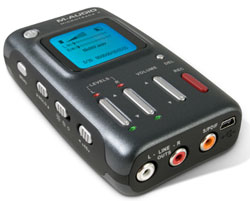
You never know when sound inspiration will strike. So you must be ready to record that unique door close or train pass. Portable recorders are so inexpensive and small these days, that there really is no excuse for not carrying one. Take a look at the Zoom H4, Sony PCM-M10, M-Audio Microtrack II, Roland R-05, or Tascam DR-08. Take a look at our Zoom H4 review here.
2. Invest in an education.
An audio education is not the be-all and end-all. But a background in audio from an accredited college or university will be a definite asset when looking for that first gig. Attending a music production school, recording school, or post production school will give you the background theoretical laws that you will soon push and break when in the real world.
3. Learn scripting.
There are many reasons to try your hand at scripting, especially if you are looking to make yourself more valuable to potential game developers. Not only will you be able to think more along the lines of a programmer for certain tasks, but you will often be able to script in audio events that programming simply does not have time for. Dynamic events such as mixer changes that are triggered by game play events, as well as more complex functions such as triggering audio to play based on certain conditions in the game are all possible with basic scripting. Lua is a great script to learn and is relatively easy for those without prior programming knowledge.
4. Develop a mixing strategy (your voice).
Every single person enters this world not knowing a language. As young children we learn how to speak, spell, and write. So it should be for your audio career. Listen to other games as well as movies and music. Analyze what you are hearing instead of passively enjoying the sound, and ask yourself why something works or does not work sonically. Mixing is a complex subject that requires more than just a paragraph write up, but thinking about your approach is a great first step.
5. Focus on things other than sound design.
Sometimes the best sources of inspiration come from sources that a different than what we normally turn to. I often find that looking at art at a gallery can be a great refresher when I'm creatively burnt out. Finding another creative outlet will help to influence your sound design, recording, and mixing. Take a look at our Writer's Block article here for more ideas.

6. Study the masters.
Everyone needs a mentor. And if you aren't fortunate enough to either be working in a game studio with a sound designer who has been around the block, or have worked alongside someone who is willing to pass on some of their skills to you, listen as much as you can to the masters. Everyone needs to develop their own style but paying attention to what was done before you goes a long way. Sound designers such as Randy Thom, Ben Burtt, and Garry Rydstrom are a great place to start. All it takes is a Google search.
7. Practice your craft and work hard.
This should go without saying, really. Nobody is born great, we all have to start somewhere and hone and apply our craft day in and day out. Everyone has bad days now and then, and every sound designer sometimes does not feel like creating. This is normal, and is part of being a creative individual. But the harder you try to accomplish a given task, the more chance of success and discoveries you will have. Some of the best sounds I have created have come to me when trying to design something completely unrelated. You just file that idea away, and come back to it at a later time. You truly do learn by doing.
8. Don't use the Wilhelm Scream.
Don't rely solely on stock library effects. Sure, commercial libraries are great for combining raw elements into a brand new sound, but simply pulling that same door close or fireball whoosh sound from Sound Ideas will not build your skills. Work hard at building your own database of custom recorded sounds and only fall back on the libraries for additional layers to your sounds or for those really hard to find or record sounds.
9. Don't get too hung up on gear.
This is perhaps one of the hardest things that new sound designers fight with constantly. They think "if I buy this piece of gear I will be a better sound designer or mixer". Not true. Sure, you need tools to get the job done, but the set of tools that are the most valuable to you are your ears. Do anything and everything to make the connection between your ears and your brain better. Think about sound that you hear in games and ask yourself "could I make that better?", and if so, how? Recording software and hardware falls in and out of fashion, but the key is to know how and why to create a sound. Always remember that once you learn how to create, implement, and most importantly what makes a sound work will be infiniteley more valuable than the latest Pro Tools, Logic, Cubase, or Sonar digital audio workstations.
10. Leave the ego at home.
This cannot be stressed enough. I have worked in sound for over eleven years and yet, each and every day I learn something new. Why? Because I am open and receptive to new ideas. That is key to becoming a great sound designer. You have to build on previous knowledge and the only way to do that is to check your ego at the door. The realization that you do not know everything and never will is a powerful, yet overlooked aspect to one's audio education. The more you are willing to listen to outside suggestions and influences the better sound designer you will eventually become.
11. Make mistakes.
Ok, so I lied. This list actually contains 11 things to make you a better game sound designer. I saved this one for last partly because it relates to number 10 above, but more importantly because it is perhaps the most important of all the suggestions listed here. I cannot stress this enough. You must be prepared to fail and make mistakes. If you do not make mistakes and fail occasionally you are doing something wrong. You must take chances in your audio and sound design. Sure, you will make stupid and idiotic errors from time to time. But you will never advance past hobbyist to a full fledged sound designer who is in demand by production companies and game developers unless you continually try new things and push your comfort zone. See how far you can go in a direction that you would not normally take. You may be surprised at the results of what you can achieve. If the end result does not work out then you at least have learned something along the way that will combine and form to make you a unique sound artist with potential and a unique voice. We need more sound designers with their own voice and experience to push the art and craft further.